There has been no lack of headlines when it comes to international student recruitment. Whether it's related to fluctuations in incoming student numbers, ever-changing visa regulations or less than welcoming policies for international students, the higher education sector has gone through it all in the last few months
And we haven't been left unscathed. But while the situation may feel dire at times, there are options and the team at Prospects can offer solutions to reduce the risk.
1. The current storm
a. Some of the strongest fluctuations are in the postgrad market
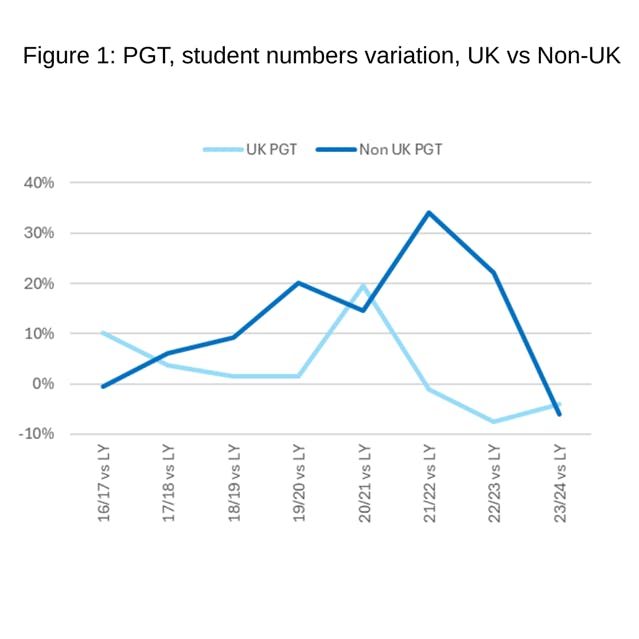
The postgraduate taught (PGT) market has seen some of the strongest variations in the last few years. The graph below shows the PGT students' numbers year-on-year change. It is divided between UK and non-UK domicile students.
The UK segment averages a variation of 3% over nearly a decade. In comparison, non-UK countries average a variation of 12%, three times the UK. This equates to a net gain over the same period of 62,000 students from UK domicile. For non-UK this is a net gain of 216,000.
b. The historical dominance of China ended, so are we now more diversified?
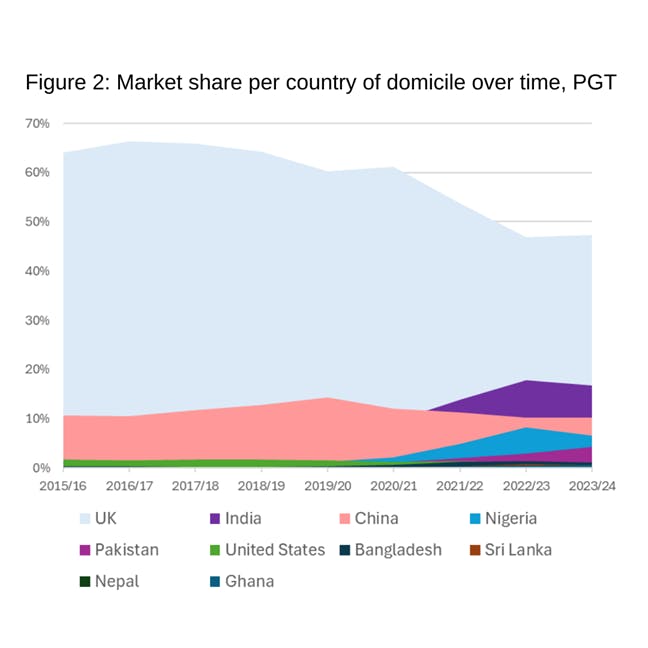
China has historically dominated our PGT market. Its market share has remained stable, oscillating between 10% and 14%. Meanwhile, the UK domicile share, as you can see below, has drastically dropped from 64% to 47%, just under the half mark.
This could make us think that the rest of the market, which used to only be 25% (in 2015), has now reached 42%. We could think the PGT market here in the UK has diversified, with the UK's provision being attractive to more countries. But is that really the case?
Before we answer this question, let's define diversification. Interestingly the investment market has a fitting definition: the spreading of your investments both among and within different asset classes.
c. HE powerhouses
If we look at all countries sending students to the UK, one country would bring on average 1,770 per year in 2015. This has increased to nearly 3,000 in 23/24 (2,993). Meaning, we are not recruiting from more countries, but rather, a select few are bringing in more students. There is less diversification overall because while China has become less prominent, the market share of the other countries has grown over the last few years.
It does not mean we are more diversified as a market.
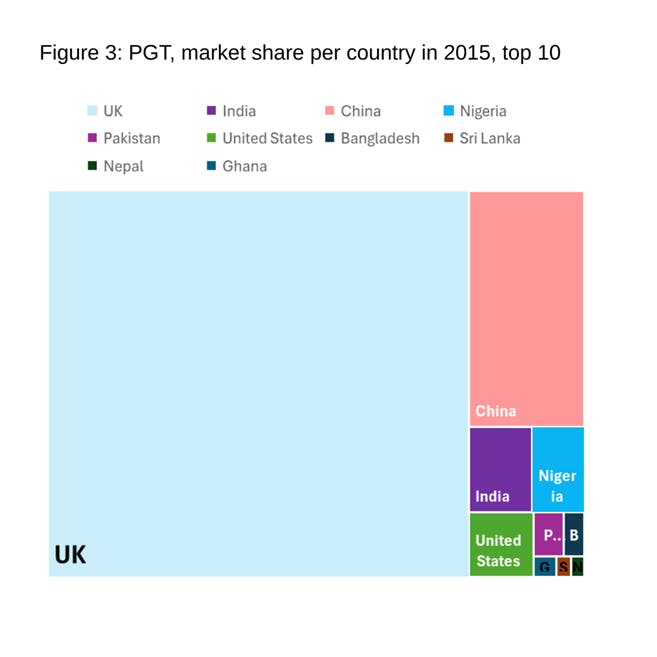
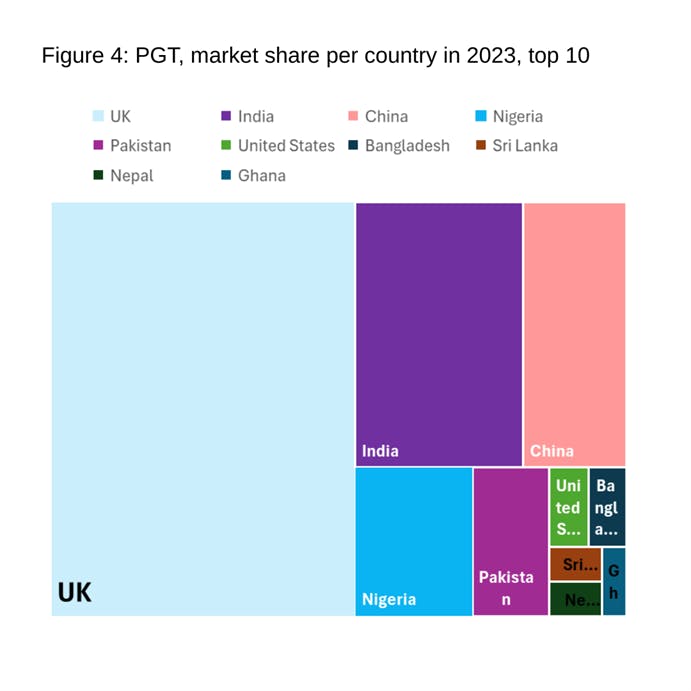
These two graphs, above, can help us to understand that although we have recruited regularly from China, it hasn't transformed into an over-reliance. But we have grown really fast in a few key markets, namely India, Nigeria and Pakistan. Our HE powerhouses. These three markets are solely responsible for 62% of the total PGT market growth since 2015.
2. Short-term solution, short-term erratic gain
a. The race for next golden unicorn
You might start to wonder where the problem lies. Strong growth, in only a few years, helping to sustain a slight declining or plateauing demand in-house or from the EU.
This is what we call the race for the next golden unicorn. For a few years it has been India, with growth accelerating from 2019. Then we have seen a surge from Nigeria, potentially not expected, from 2020 onwards, to the point where in 2024, it was responsible for more dependants' visas in absolute numbers than India. Then came Pakistan in 2021, followed by a surge from Bangladesh in 2022.
Each year, we get asked, where is the next big market? Where should I focus my recruitment efforts next year?
b. Uncertainty and volatility come into play
The flaw with such a plan is its inability to be forecasted accurately. Those countries we are now heavily reliant on, are also unfortunately highly volatile and uncertain.
The factors driving this volatility are hard to predict. Population growth is an element we can forecast with relative accuracy. But some other elements play a part. For example, the Naira, the Nigerian currency, crashed in 2023, going from ₦ 500 = £1, to ₦ 1,900 = £1. Taking as an example a generic university's international fees of £19,500 for 2026 entry, it would be as if you'd increased fees to a Nigerian student to £74,100 in relative terms.
Other external factors have caused fluctuations on student numbers, from political alignment to visa restrictions, and limitations of real estate (specifically limited student housing in case of New Zealand for example).
A key common element to most of these factors, is that they're outside of our control. We might get short term gains, but these will be erratic and difficult to sustain.
A solution to shift the tide towards sustained growth is diversification. This will help towards strengthening universities' financial stability.
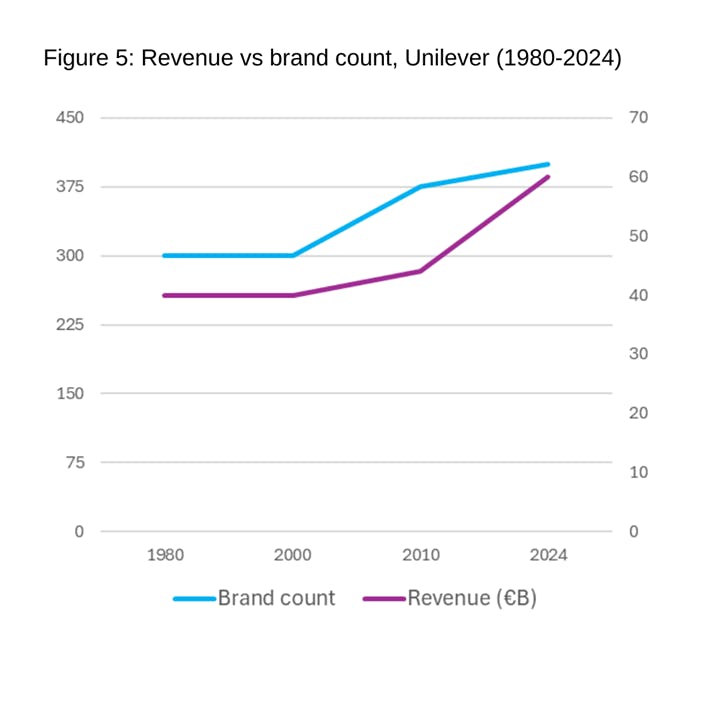
Examples come aplenty from the FMCG market which is a few years' ahead in terms of adaptability to change. From Amazon expanding from bookstore to media, logistics and software, to Apple moving from just hardware to software and wearables, the success stories of diversification show their potential impact on revenue. We could also name more traditional brands like Unilever, which has increased its revenue with acquisitions and diversification.
3. Long term solution for engrained success
a. Diversity, but not on its own
First, we'd recommend an audit of your feeder countries. Jisc's data analytics team can support you to understand where you recruit your students from. You should also look at where you might have an over-reliance on a particular country per subjects. For example, India brings 33% of the total students on PGT in Business (CAH 17). But other subjects like computing and engineering are not far behind.
The key here is to broaden your source to lessen unique reliance. By broadening your source, you make yourself less at risk of changes in visa regulations and other potentially unpredictable external factors to weather the storm.
But diversity on its own will not ensure the best outcome. Predictability needs to be considered. For this, Jisc's data analytics team uses Shannon entropy and can work with your current portfolio to understand where best to plan your recruitment activities.
The idea is to find and establish three categories:
- Current powerhouses - those countries where your offering is known and valued, fairly safe pipeline.
- Missed opportunities - those countries which are interested in the subjects you offer but do not know your university yet, a reasonable investment as you do not have to promote the subjects or the destination, they know it/already established.
- Wild cards - high potential yield, but high risk as category not developed there yet.
We can look back at an example cited earlier - Unilever grew its number of brands to 400 over the last 40 years. So, the diversification part is done. But this is only a part of their strategy. They focus their effort on 30 established brands, which are global (our powerhouses equivalent). Then they get additional revenue from smaller more local brands. They might not bring as much yield but can be more flexible and adapt or move faster.
b. Tactics and budget split
When a university has successfully established its three categories to target, a tough decision comes in the budget split. A diversification strategy can be costly, much more than just going after your golden unicorn. But as we've established, the reward is also greater.
At Prospects, we've got a lot of experience running international campaigns. We would recommend splitting your budget, for example following the below:
- Maintain - 30% to your powerhouses. They know the offering and your university so the cost should be lesser. Awareness is there, conversion is the focus.
- Focus - 60% to your missed opportunities. This means you invest more and longer term in those markets you are not yet reaching. There are heavy costs associated as you need to build awareness and conversion.
- Develop - 10% to your wild cards. A smaller chunk of budget, to reduce the risk (as these are highly unpredictable markets), but it does means you can make the most of surges/bursts without huge risk.
c. Diversification campaign and solutions
Now your target is established, and your budget is set, the next decision is to pick the right channel. As you've diversified the source (countries or market you recruit in), you also need to diversify the medium (channel used to reach those countries/markets).*
- Spotify can be a great tool to develop awareness via music and podcast placement. The average time spent streaming music daily in India is 1h 49 (We are Social report), versus only 1h 07 per day in the UK. But in India only 22% pay for the service (so there is an opportunity for ad placements). India is also the second country worldwide in terms of time listening to podcast daily (1h 19).
- Signals (Display and Video) can be used, incorporating our knowledge of the HE markets with floodlights to retarget those interested.
- We have historic data in quantity, to be able to draw patterns from similar regions, and group them in similar CPC behaviour.
The team at Prospects can support you to draft a strategy encompassing sector-leading insights and implement them in a multi-channel campaign. Contact us, if you want to know more about our solutions, on postgraded@jisc.ac.uk
Notes
*To take this even further, you could diversify the entry route (i.e. progression from UG, TNE, direct to PG).
Written by

Was this page useful?
Thank you for your feedback